Reality-Based Practice
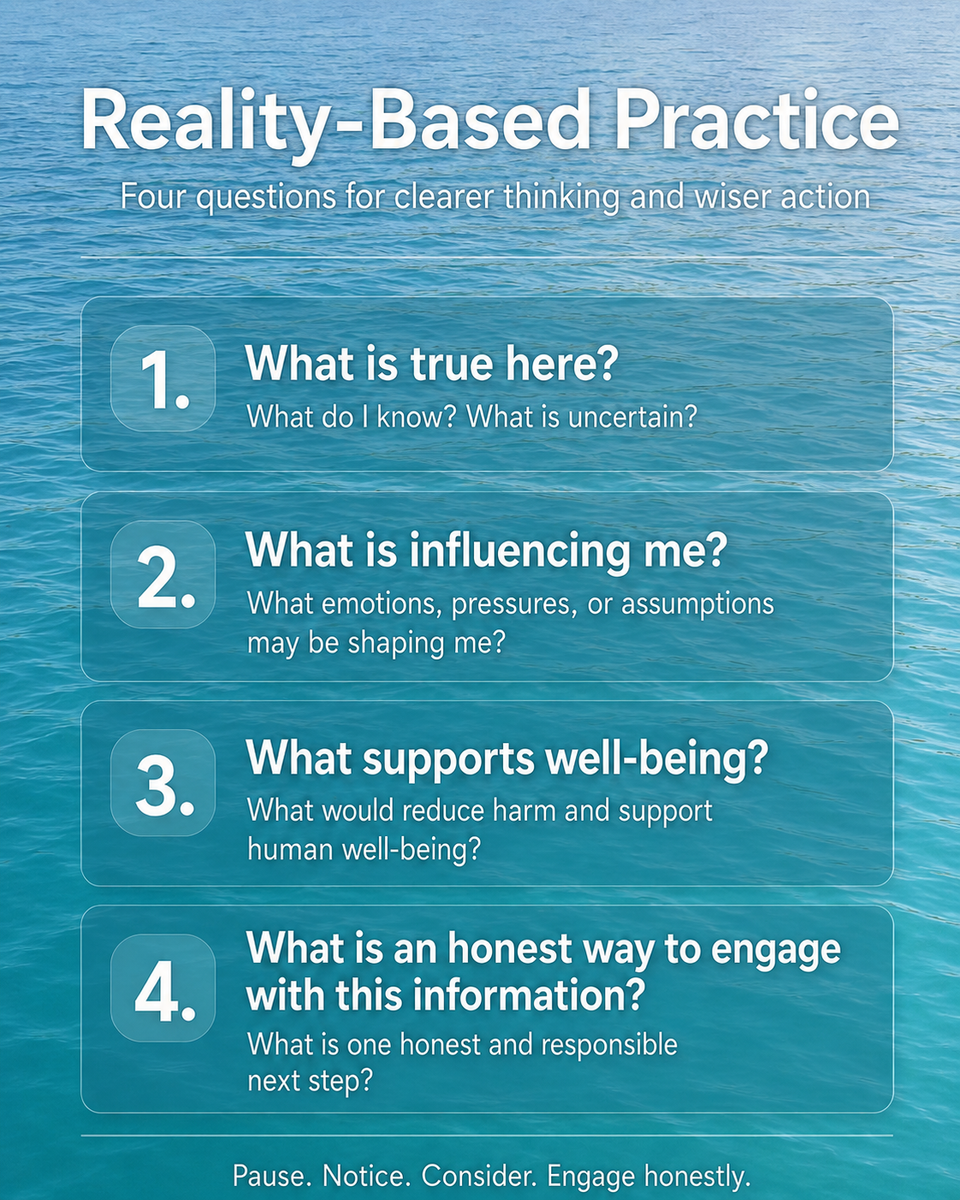
The Reality-Based Reflection Tool: Four questions for seeing more clearly and responding with wisdom and honesty
Reality-Based Living is not only about understanding ideas. It is about learning how to pause, reflect, and respond more honestly in real life.
Reality-based practice can take many forms, but this page begins with the Reality-Based Reflection Tool, a simple four-question process designed to help us pause, reflect, and respond more honestly.
These questions are meant to help us slow down, examine what is real, notice what may be influencing us, consider well-being, and choose an honest way to engage with the information we gather.
The four questions are:
- What is true here?
- What is influencing me?
- What supports well-being?
- What is an honest way to engage with this information?
Free Printable W.I.S.E. Quick Reference Card
You can also download the free printable W.I.S.E. quick reference card to keep these questions nearby.
These questions are not meant to make us perfect. They are meant to help us become more aware, more responsible, and more willing to meet reality with honesty and care.
1. What is true here?
The first step is to return to reality as honestly as we can.
This means asking:
- What do I actually know?
- What is uncertain?
- What might I be assuming?
- What evidence do I have?
- What information might I be missing?
- What is actually happening, as best I can tell?
- What details am I overlooking or avoiding?
This question helps us begin with what is real, not only with what feels true, familiar, comfortable, or convenient.
2. What is influencing me?
The second step is to notice what may be shaping the way we see the situation.
This may include:
- Emotion
- Fear
- Pride
- Comfort
- Anger
- Stress
- Habit
- Group pressure
- Past experiences
- Cultural messages
- Personal incentives
- The desire to be right
- The desire to avoid discomfort
This question is not about shaming ourselves. It is about becoming more aware of the forces that may be affecting our judgment.
We are all influenced by something. The danger is not only influence itself. The danger is being influenced without noticing it.
This means asking:
- What emotions may be shaping how I see this?
- What pressures may be affecting my judgment?
- What story am I telling myself about what is happening?
- What do I want to be true?
- What would be uncomfortable to admit?
3. What supports well-being?
The third step is to consider the human consequences of our response and the responses of others.
This means asking:
- What would reduce unnecessary harm?
- What would support honesty and responsibility?
- What would protect human dignity and trust?
- What would support health, stability, and human well-being?
- Who may be affected by this choice?
- Are we considering the likely effects on well-being, not only the stated intentions?
This question helps keep truth connected to care.
Reality-Based Living is not about using truth harshly or selfishly. It is about trying to see more clearly so we can live more wisely, responsibly, and humanely.
4. What is an honest way to engage with this information?
The fourth step is to choose an honest way to respond to what has been noticed.
This may mean:
- Speaking honestly
- Listening more carefully
- Asking a better question
- Admitting uncertainty
- Taking responsibility
- Setting a needed boundary
- Apologizing
- Changing direction
- Seeking help
- Waiting before reacting
- Taking a practical next step
The honest way to engage is not always dramatic. Sometimes it is quiet, simple, and small.
The goal is not to find a perfect answer or the only right response. The goal is to take a step that is more aligned with reality, care, and responsibility.
A simple English memory aid: W.I.S.E
In English, these four questions can be remembered as W.I.S.E
W — What is true here?
I — What is influencing me?
S — What supports well-being?
E — Engage honestly
The acronym is only a memory aid. The deeper practice is the four-question reflection itself.
This is important because the content of Reality-Based Living is meant to be understandable across different languages, cultures, and life experiences. The wording may change, but the practice remains the same:
See what is true.
Notice what is influencing you.
Consider well-being.
Engage honestly with what you have noticed.
When to use this practice
Reality-based practice can be useful when:
- You feel emotionally reactive
- You are facing a difficult decision
- You are in conflict with someone
- You feel certain but may need to slow down
- You are avoiding something uncomfortable
- You are trying to understand a pattern in your life
- You want to respond with more honesty, wisdom, and care
It can be used in a few seconds, a few minutes, or as part of deeper reflection.
A necessary caution
This practice is not a formula for perfect decisions.
It does not remove uncertainty.It does not guarantee that we will always see clearly.It does not replace professional support when that support is needed.It should not be used to shame ourselves or others.It should not be used to delay necessary action when safety or urgency is involved.
It is simply a tool for reflection.
Used with humility and practiced over time, it can help us become a little more honest, a little more careful, and a little more responsible in how we meet reality.
A practical way to begin
Choose one situation in your life where you want more clarity.
Then ask:
What is true here?
What is influencing me?
What supports well-being?
What is an honest way to engage with this information?
You do not need to answer perfectly.
Just begin honestly.